

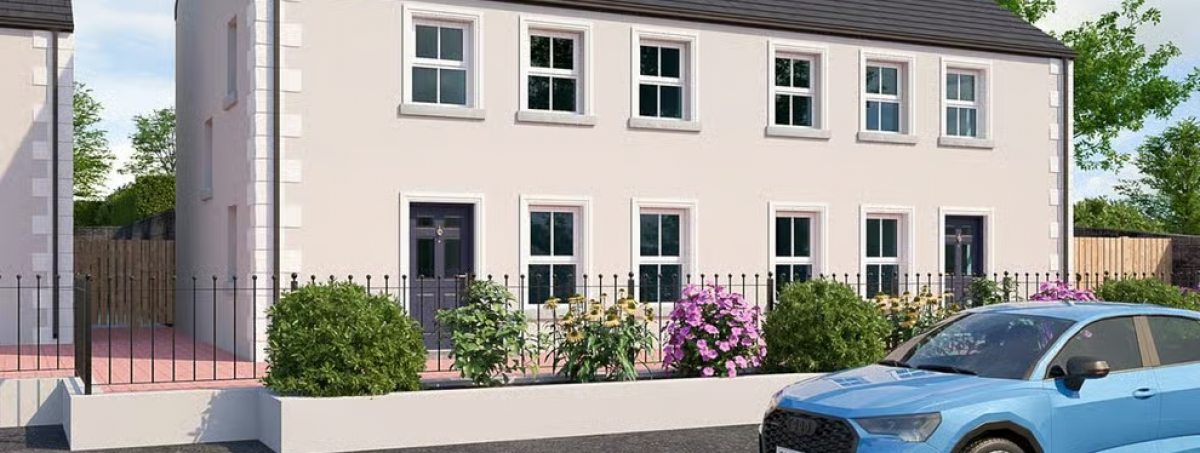
Meeko Construction has delivered six new homes in Omeath, Co Louth, funded through peer-to-peer platform Property Bridges rather than a bank loan, a financing route the developer says let it start building without the delays typical of traditional bank finance.
Meeko Construction, based in Newry with operations across Armagh, Down, Louth and Dublin, is a residential building and development firm founded in 2017 by Ryan Meehan, employing around 17 staff directly alongside a wider subcontract workforce.
Property Bridges, Ireland's only dedicated crowdfunding platform for homebuilding finance, is backed by a community of more than 2,600 individual investors funding loans of €500 to €500,000 into asset-backed residential developments.
Arda Oberon comprises six three-bedroom family homes in Omeath priced from €390,000, with construction expected to complete in 2026, addressing demand in a county where an estimated 8,385 additional homes are needed by 2030. Construction of the homes has also driven local economic activity, creating employment among contractors and suppliers in the area during the build.
Investors received the platform's targeted annual return of 7.5%; the total loan size for the project was not disclosed.
This is the second Property Bridges-financed scheme this vertical has covered in recent weeks, and the pattern that matters is not the platform itself but where it operates: cross-border, rural and small-town Ireland, where bank appetite for small developer loans is thinnest.
The Department of Finance's own timeline for the housing crisis underlines why that gap will persist: housing demand is not expected to peak until the early 2030s, with pent-up demand not fully eliminated until at least 2040, meaning small, quickly financed schemes like Arda Oberon will remain necessary well beyond any single funding cycle.
Six-unit developments in towns like Omeath rarely justify the overhead of a full bank lending process for either the developer or the lender, which is precisely the gap crowdfunding platforms are positioned to fill.
For the sector, construction employment generated by these small schemes is spread across a wider base of local contractors and suppliers than a single large-scale development would support, giving border-county builders a steadier route to site starts than waiting on larger, slower-moving projects to reach construction.
Source: Louth Live / The Irish Times











.png)